When your electricity bill keeps creeping up, the difference between single rate versus time of use stops being a technical question and starts being a household money question. If you charge an EV at home, run appliances overnight or are considering a home battery, the tariff you choose can make a noticeable difference to what you pay each month.
What single rate versus time of use really means
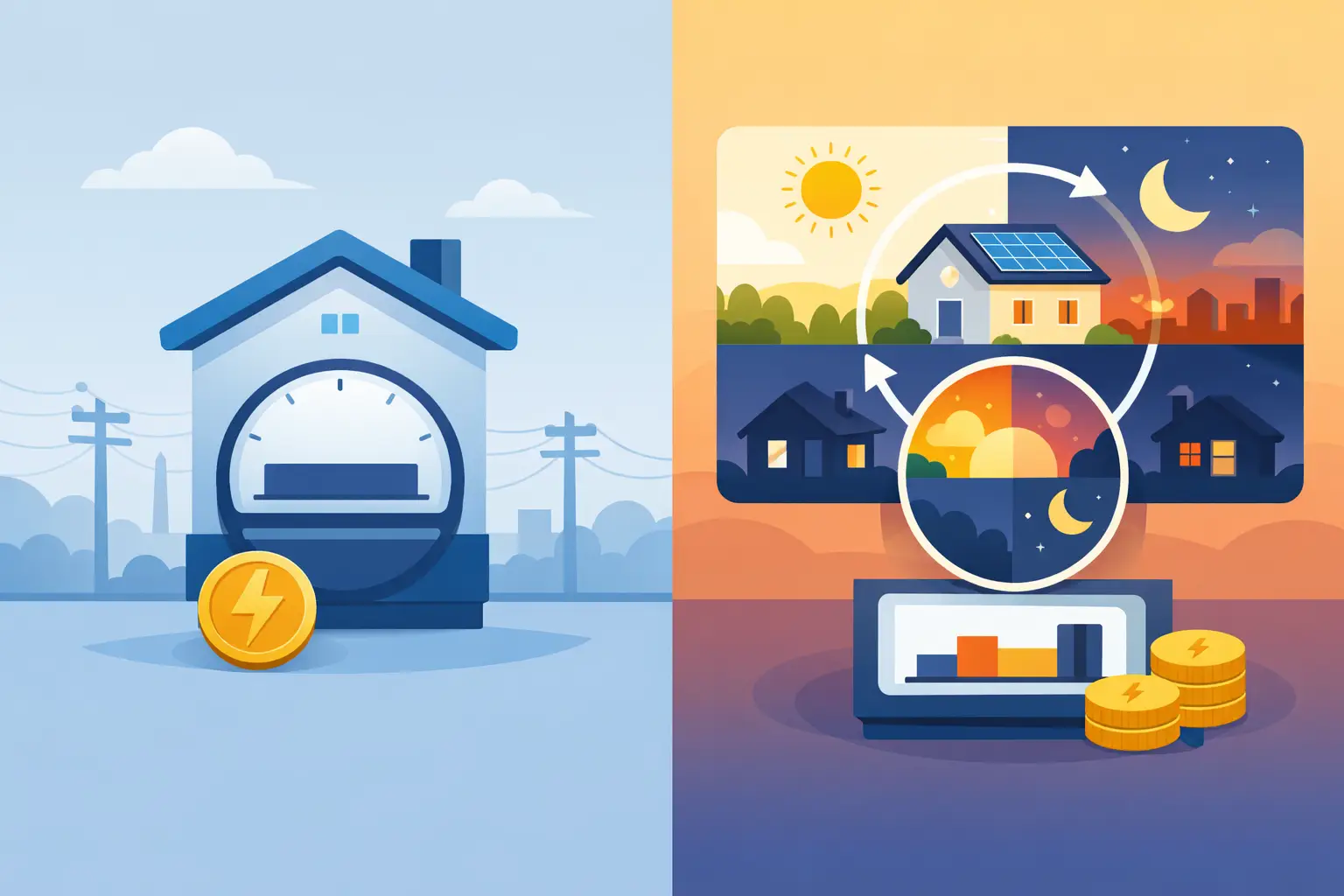
A single-rate tariff is the simpler option. Every unit of electricity costs the same, whether you use it at 2pm or 2am. That makes bills easier to follow, and for some homes that simplicity is worth having.
A time-of-use tariff works differently. Electricity is priced by time period, so some hours are cheaper and others are more expensive. The idea is straightforward: use more power when demand on the grid is lower, and you can cut your costs.
This matters because most homes do not use electricity evenly across the day. Evening cooking, showers, washing and EV charging can all land in higher-priced periods. If your tariff rewards off-peak use, shifting some of that demand can work in your favour.
Why the right tariff depends on how your home uses power
There is no universal winner in the single rate versus time of use debate. The better option depends on your routines, your flexibility and whether you have technology that helps you move electricity use to cheaper hours.
If someone is home all day, cooking, heating water and running appliances in the afternoon and evening, a time-of-use tariff may not automatically save money. The cheaper night rate can be attractive, but the peak rate can cancel those savings if most of your usage stays in expensive periods.
On the other hand, homes with an EV often have a clear opportunity. Charging a car overnight is one of the easiest ways to take advantage of lower off-peak pricing. The same applies if you can run a dishwasher, tumble dryer or washing machine later in the evening or overnight.
The strongest case for time-of-use often comes when a household combines flexible usage with battery storage. A battery can charge from the grid when electricity is cheaper, then supply the home later when electricity costs more. That changes the equation because you are not relying only on changing habits. You are also using stored lower-cost electricity more intelligently.
Single rate versus time of use for EV charging
EV charging is where tariff choice becomes much more visible. A car can add a large amount of electricity demand to a home, so the rate you pay for those units matters.
With a single-rate tariff, EV charging is predictable but not especially strategic. You pay the same unit rate whether the car charges after work or during the early hours. That may suit drivers who want complete simplicity, but it usually means missing the cheaper windows that some EV-friendly tariffs provide.
With time-of-use pricing, an EV becomes an opportunity rather than just an extra cost. If the car charges overnight during lower-rate hours, the cost per mile can drop significantly. For households doing regular mileage, that difference adds up across the year.
Simple EV tariff comparison diagram
Here is a basic example to show the principle:
| Tariff type | Day rate | Night rate | EV charging pattern | Likely outcome | |—|—:|—:|—|—| | Single rate | 27p/kWh | 27p/kWh | Charge any time | Simple, but no off-peak savings | | Time of use | 32p/kWh | 9p/kWh | Charge overnight | Lower EV running cost if charging is shifted | | Time of use plus battery | 32p/kWh | 9p/kWh | Charge EV overnight, battery stores cheap power for house | Greater chance of reducing overall household bills |
These are illustrative figures, not a tariff quote, but they show the trade-off clearly. If your car can reliably charge during the low-cost window, time-of-use pricing can be attractive. If you regularly need to charge during the day, the benefit can narrow.
Where battery storage changes the picture
Without a battery, time-of-use savings rely heavily on behaviour. You need to remember to shift usage, schedule charging and avoid expensive periods where possible. Some households can do that easily. Others find real life gets in the way.
Battery storage gives you more control. Instead of trying to move every household activity into a low-cost window, the battery stores cheaper overnight electricity from the grid and makes it available later. That can help reduce reliance on higher daytime and evening rates.
For many UK households, this is the practical advantage. You do not need to produce your own electricity to benefit from battery storage. You are using the tariff more effectively by buying power when it is cheaper and using it when it would otherwise cost more.
That matters even more in homes with an EV. Overnight charging can cover the car, while a battery supports daytime and evening use in the house. Rather than treating the EV as a bill problem, you start to use the tariff structure as part of a wider savings strategy.
Household and EV charging diagram
This simplified diagram shows the difference:
| Time of day | Single rate home with EV | Time-of-use home with EV and battery | |—|—|—| | Overnight | EV charges at standard unit rate | EV charges at low rate, battery also charges at low rate | | Daytime | Home uses standard unit rate | Home can use stored lower-cost electricity | | Evening peak | Cooking, lighting and appliances at standard unit rate | Battery can reduce need to buy peak-rate electricity |
The practical aim is simple: buy more electricity at the cheaper rate and less at the expensive rate.
When single rate can still be the better choice
Single-rate tariffs should not be dismissed. For some homes, they remain the more sensible option.
If your electricity use is fairly even across the day, and you do not have an EV or battery, the difference between tariff types may be smaller than expected. The higher peak prices on some time-of-use deals can leave you worse off if you cannot shift enough usage.
Single rate can also suit households that want certainty and ease. One rate means fewer variables, easier comparisons and less need to monitor when electricity is used. For busy homes, that simplicity has value.
There is also the question of tariff discipline. A time-of-use tariff only works well if your actual usage pattern matches the cheaper hours. If not, the tariff can look good on paper but disappoint in practice.
Questions to ask before switching
Before choosing between single rate versus time of use, it helps to look at your home honestly rather than ideally. The right question is not whether you could shift usage. It is whether you actually will.
Think about when you use the most electricity now. If your largest demand is overnight EV charging, a time-of-use tariff may be a strong fit. If your biggest usage is concentrated in the evening and cannot easily move, the result may be less favourable.
Then consider whether a battery would change that. A battery can reduce the pressure to change household habits because it does some of the work for you. That is one reason more homeowners are looking at grid-charged battery systems as a practical route to lower bills without the complication of solar.
It is also worth checking the details of any tariff, not just the headline off-peak rate. The length of the low-rate window, the cost during peak periods and any standing charge all affect the final outcome.
A practical way to think about savings
The simplest way to compare tariffs is to look at three areas: your everyday household use, your EV charging and your ability to store cheap electricity for later.
If you only change one thing, changing when you charge an EV can make a meaningful difference. If you add battery storage, the benefit can extend beyond the car and into the rest of the home. That is where many households start to see a more consistent saving rather than just occasional off-peak gains.
For homeowners who want a straightforward route to lower electricity costs, the best answer is often not the tariff alone. It is the combination of tariff and technology. Used well, a battery charged from the grid can turn a time-of-use tariff from a nice idea into a more reliable bill-saving system.
Volt Wiser Energy focuses on that practical outcome – helping households use lower-cost electricity more effectively, with clear guidance, qualified installation and no need for solar panels.
If you are weighing up single rate versus time of use, start with your real usage pattern, not the sales pitch on a tariff page. The best choice is the one that fits how your home actually runs and gives you more control over what you spend.