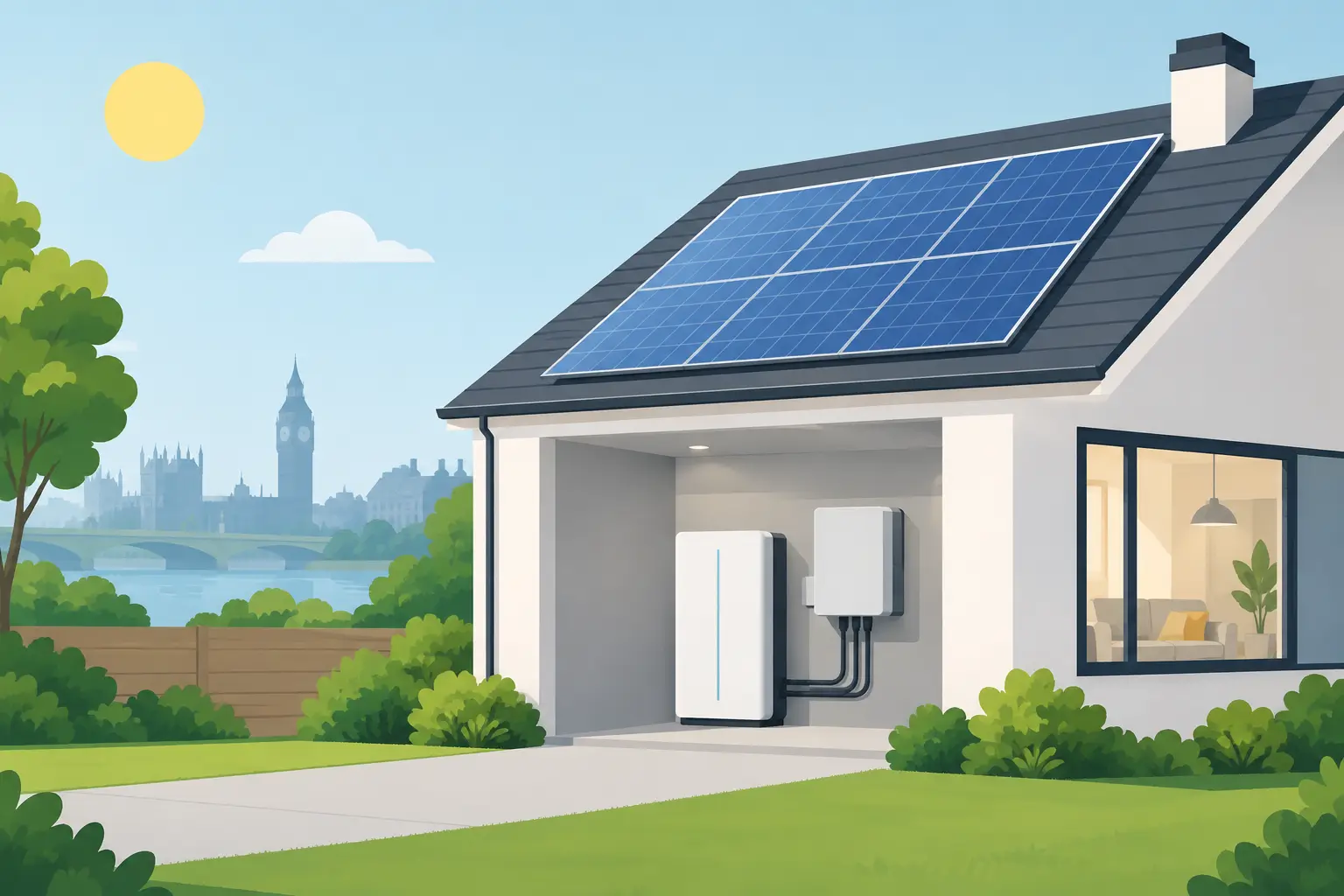

If your electricity is cheap at 2am and expensive at 6pm, the obvious question is how to store cheap grid electricity so your home can use it later. That is exactly what a domestic battery system is designed to do. It charges when your tariff is low, then supplies that stored power back to your home when rates rise.
For many UK households, this is a more practical route to lower bills than people realise. You do not need panels on the roof. You do not need to become an energy expert. You need a battery, the right tariff, and a setup that is properly sized and installed for the way your home actually uses electricity.
How to store cheap grid electricity at home
The principle is simple. A home battery takes in electricity from the grid during off-peak hours, stores it, and then releases it later when electricity costs more. Instead of buying most of your power at the daytime rate, you shift part of your usage to the cheaper electricity you bought earlier.
Think of it as buying ahead. Your tariff gives you a lower overnight price window. The battery fills up in that window. During breakfast, daytime working hours and the evening peak, the battery discharges to run lights, appliances and other household demand.
This matters because the gap between cheap and expensive electricity can be large enough to make storage worthwhile. The bigger that gap, and the more of your daily usage you can shift, the stronger the savings case tends to be.
Why a battery works better than simply using power overnight
Some households already try to save money by running the dishwasher late or putting the washing machine on before bed. That can help, but it only moves the appliances you are willing to run at odd hours. A battery does more than that. It shifts electricity itself.
That means your home can still use cheaper stored power at normal times of day, when you actually want to cook, boil the kettle or charge devices. It turns a tariff feature into something usable, instead of asking you to reorganise your whole routine around a few low-cost hours.
There is also a comfort factor. Most people do not want to think about timers every day. A battery system, once configured properly, does the work in the background.
What makes storage worthwhile
Not every home will save the same amount, because the result depends on usage patterns. Homes with higher evening demand usually benefit more than homes that use very little electricity after midnight. If you are often at home during the day, cook in the evening, or charge an electric vehicle at home, the case can be stronger.
Battery size matters too. A small battery may only cover part of your peak-time use. A larger one can shift more energy, but it costs more up front. The right answer is not always the biggest unit. It is the one that matches your home well enough to make the savings meaningful without overspending.
Tariff structure is just as important. If your overnight rate is only slightly lower than your daytime rate, the savings margin may be modest. If there is a clear difference between the two, storage becomes more attractive.
The role of EV tariffs in household savings
Electric vehicle tariffs have changed the conversation. Many of them offer low overnight electricity prices aimed at home charging, but those cheap-rate windows can often benefit the whole house, not only the car.
That creates a useful opportunity. If your battery charges during the same low-cost period as your car, you can use that cheaper electricity across more of your household demand the next day. In the right setup, the tariff designed for the EV also helps reduce the rest of your electricity bill.
The key is capacity and timing. If your EV and your battery both need to charge overnight, the system needs to be planned so one does not cancel out the benefit of the other. In some homes that means charging the car every night and topping up the battery with the remaining cheap-rate window. In others it means prioritising the battery on lighter driving days and the car when mileage is higher.
EV tariff comparison diagram
Below is a simple illustration of how home battery storage can work alongside an EV tariff to reduce household costs.
| Tariff type | Cheap-rate window | Best use case | Household bill impact without battery | Household bill impact with battery | |—|—|—|—|—| | Standard flat tariff | Same rate all day | Homes with no time shifting | Limited savings opportunity | Battery savings usually weaker | | Time-of-use tariff | Short overnight low-rate period | Homes able to shift usage | Some savings from manual appliance timing | Better savings by charging battery overnight | | EV tariff | Low overnight rate for home charging | EV owners charging at home | EV charging cheaper, daytime home use still costly | EV charging stays cheap and stored power can support daytime household use |
And here is the same idea as a simple timing diagram:
| Time | Grid price | EV action | Home battery action | Household effect | |—|—|—|—|—| | Overnight | Low | Charge car if needed | Charge battery | Buy cheaper electricity | | Morning | Higher | Usually idle | Battery discharges | Reduce peak-rate import | | Afternoon | Higher | Usually away or idle | Battery discharges or holds reserve | Lower daytime cost | | Evening | Highest in many tariffs | Usually idle | Battery supports home demand | Reduce expensive evening usage |
The exact savings depend on the tariff terms, how often you charge the car, and how much electricity your home uses outside the overnight window. But the logic is straightforward: use the cheap period to serve more of tomorrow’s demand.
How to choose the right setup
Start with your actual electricity use, not the advertised capacity of a battery. A good assessment looks at when you use power, not only how much you use in total over a month. Two homes with the same annual consumption can have very different savings potential if one uses most of its electricity in the evening and the other spreads usage more evenly.
Then look at your tariff. The value of storage comes from the difference between low and high rates. After that, consider whether you have an EV, whether home charging is regular, and whether your fuse board and installation space are suitable.
This is where clear advice matters. A dependable installer should explain expected performance in plain English, set realistic savings expectations and show how the battery will be programmed to suit your tariff. That is more useful than overpromising based on ideal conditions.
Common questions homeowners ask
One concern is whether a battery will power the whole house all day. Usually, no – and that is not the point. The aim is to offset enough peak-rate electricity to make a noticeable difference to your bills. Some homes will cover a large share of daytime use. Others will reduce only the most expensive part.
Another question is whether this works without roof panels. Yes. A battery can be charged directly from the UK grid. For households who want lower bills without the added complexity of rooftop generation, that is often the appeal.
People also ask about safety and reliability. These are sensible questions. The answer depends on product quality, correct system design and professional installation. A well-specified battery system from a credible UK-backed supply chain, installed by qualified professionals, should be presented as a long-term household energy asset, not a gadget.
When it may not be the right fit
Storage is not a magic answer for every property. If your tariff does not offer a worthwhile cheap-rate window, if your electricity use is already very low, or if most of your demand already happens overnight, the savings may be limited.
It also may not suit households looking for instant payback. A battery is a longer-term bill reduction measure. The financial case improves when prices remain variable over the day and when the battery is used consistently.
That said, for many ordinary grid-connected homes, especially those with an EV on a time-based tariff, battery storage can be a practical way to take back some control over energy costs. This is why businesses such as Volt Wiser Energy focus on straightforward education and proper system matching rather than hype.
The simplest way to think about it
If you can buy electricity cheaply at night and use it later when prices are higher, you are not changing how much power your home needs – you are changing when you buy it. That is the real answer to how to store cheap grid electricity.
For homeowners trying to cut bills without adding major disruption, that shift can be surprisingly valuable. The smartest energy upgrade is often the one that works quietly in the background, makes sense on the numbers, and lets your home run as normal.