
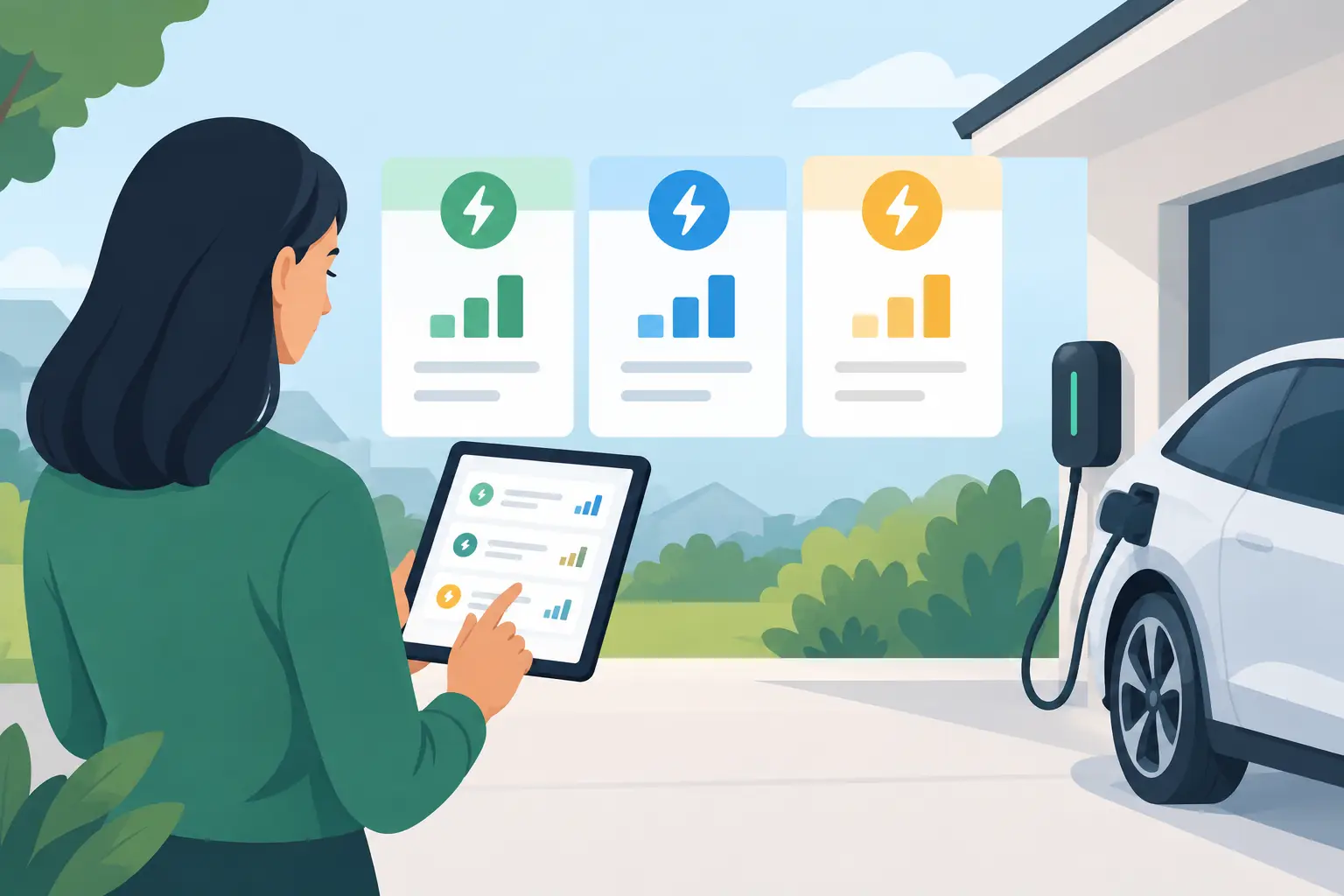
A low overnight EV rate can look excellent on an advert, then cost more than expected once the daytime rate, standing charge and charging window are taken into account. To compare EV charging tariffs properly, look beyond the headline pence-per-kWh figure and calculate what the tariff means for your whole household – not only for the miles you drive.
For many UK homeowners, an electric car creates a useful opportunity: shifting a large part of electricity use into cheaper overnight hours. With the right tariff and charging routine, that can reduce running costs substantially. If you also use a home battery, lower-cost electricity can support more of your daytime household use, helping to reduce bills without fitting rooftop generation.
Compare EV Charging Tariffs by Your Actual Routine
The best tariff is rarely the one with the lowest advertised overnight price alone. It is the one that suits when you arrive home, how often you charge, how much electricity your household uses outside the discounted period, and whether you can shift other demand.
Start with your car. Find its usable battery capacity, typical miles per kWh and the amount you usually need to replace after a normal week. A driver covering 100 miles may need roughly 25 to 33 kWh, depending on the vehicle, weather and driving conditions. Someone covering 250 miles each week may need considerably more.
Then check the charger. A common 7 kW home charger can add roughly 7 kWh for every hour it operates, subject to the car and installation. A four-hour lower-price window may therefore be enough for one household, but restrictive for another. The point is not to chase the longest window automatically. It is to make sure the window reliably covers the energy you need.
Compare the full tariff, not just the cheap hours
When reviewing tariffs, record four figures: the overnight unit rate, the daytime unit rate, the daily standing charge and the exact discounted hours. Also check whether those hours apply every day, whether the tariff requires a compatible smart meter, and whether there are conditions around charging control.
A tariff with a very low overnight rate can still be less attractive if your home uses a lot of electricity during the day and its peak rate is high. Conversely, a slightly higher overnight rate may work out better if the daytime rate is more reasonable or the discounted period is longer.
It also matters whether the tariff is designed primarily for EV charging or offers low prices across a wider overnight period. A specific EV tariff may suit drivers who can schedule charging precisely. A broader time-of-use tariff can be more flexible for a household that wants to run appliances overnight or charge a battery as well.
Do not overlook the standing charge. It is paid every day regardless of how much electricity you use. It normally has less impact than unit rates in a high-usage EV household, but it belongs in a fair comparison, particularly when two tariffs are otherwise close.
Electric Car EV Tariff Comparison: Look at the Household Bill
Use your own usage figures where possible, but a simple illustration shows why the full picture matters. The rates below are examples only, not quoted offers.
“`text Electric car EV tariff comparison – illustrative rates
Tariff A Tariff B Cheap charging window 00:30-05:30 00:00-06:00 Overnight unit rate 9p per kWh 11p per kWh Daytime unit rate 32p per kWh 27p per kWh Standing charge 48p per day 52p per day
EV energy: 30 kWh/week, charged overnight Tariff A EV cost: £2.70/week Tariff B EV cost: £3.30/week
But household daytime use: 70 kWh/week Tariff A daytime cost: £22.40/week Tariff B daytime cost: £18.90/week “`
Tariff A is cheaper for the car in this example, yet its higher daytime price costs more across the rest of the home. That does not make Tariff B the right choice for every household. If most of your electricity can be shifted overnight, Tariff A may still be better. The calculation simply shows why an EV tariff should be judged as a household tariff.
Your bills or smart-meter data provide the most useful starting point. Separate your approximate overnight, daytime and evening consumption, then add the expected EV charging energy. If you do not yet have detailed data, use a few months of bills and begin with a cautious estimate. A tariff can be reviewed later once real charging patterns are clearer.
Allow for winter, travel and charging losses
Electricity use is not identical every week. Cars often use more energy in colder weather, and a longer journey can add a significant charging session. Charging itself also has modest losses, so electricity drawn from the grid can be higher than the energy that reaches the vehicle battery.
Leave headroom in your chosen overnight window. A tariff that only works in an average week may become inconvenient after a weekend away or during winter. Smart scheduling through the car or charger can help, but check that it begins and ends within the lower-rate period.
How a Home Battery Can Reduce Daytime Electricity Costs
An EV tariff can be useful even when the car is not charging every night. A properly specified home battery can charge from the grid during lower-cost hours and provide stored electricity for household use when electricity costs more. This shifts part of your home’s demand away from the expensive part of the day.
“`text Electric car EV tariff comparison with household battery
Lower-cost overnight period Grid at lower rate | +——————> EV charge for planned journeys | +——————> Home battery charge
Higher-cost daytime period Home battery ———–> Household lights, cooking and appliances Grid at higher rate ——> Only the remaining household demand
Aim: buy more electricity at the lower rate and reduce higher-rate electricity bought for normal household use. “`
This approach needs sensible planning. The battery must have enough usable capacity for the amount of daytime electricity you want to shift, while its charge and discharge power must suit the loads in your home. Its round-trip efficiency also means that not every unit bought overnight is available later. Savings depend on the gap between lower and higher rates after allowing for those losses.
There can also be competition for the overnight window. If the EV needs 35 kWh before morning and the battery needs energy for the following day, your supply, charger and battery settings need to work together. Some households have plenty of time and capacity; others may choose to prioritise the car on certain nights and the home battery on others.
Volt Wiser Energy helps homeowners assess this practical balance, with professionally installed UK-engineered battery systems designed around tariff-led savings and everyday household demand.
Check the Terms Before You Switch
Before committing, read the tariff details rather than relying on a comparison headline. Confirm the contract length, exit terms, price review arrangements and whether the supplier can change rates. Check whether the lower rate applies automatically or needs a particular charging schedule, app setting or compatible meter.
You should also ask how the tariff treats electricity used by the rest of the property during the lower-price period. For a household battery, this is particularly relevant: you want to know that overnight charging is billed as expected, rather than assuming the rate is limited to a single device.
If you rent out part of your home, use electric heating, work from home or have unusually high daytime consumption, say so when comparing your options. These details can change the result more than a one or two pence difference in the overnight rate.
Common Questions About EV Tariffs
Is the cheapest overnight rate always best?
No. It is often best for high overnight EV consumption, but a costly daytime rate can outweigh the benefit for households that use significant electricity outside the charging window. Compare total annual or monthly costs using your likely usage pattern.
Can I charge my EV every night on a lower-rate tariff?
Usually, provided your car, charger and available charging window are suitable. Set a schedule that finishes before the lower-price period ends, and remember that a large battery or a low state of charge may require more time than usual.
Does a battery make an EV tariff worthwhile?
It can improve the value of a time-of-use tariff by moving more household consumption into the lower-rate period. The outcome depends on your tariff spread, electricity use, battery size and charging requirements. A clear calculation should show expected savings before installation.
A good EV tariff should make your routine easier, not force your household to revolve around a narrow charging window. Start with the way you actually drive and use electricity, then choose the tariff and battery setup that gives you more control over the bill month after month.