If your EV goes on charge at 11pm and your electricity meter starts spinning through the cheapest hours of the day, you already know the basic trick. The question is how to make more of those cheap hours. The best battery setups for EV owners are not always the biggest or most technical. For most UK households, the right setup is the one that stores lower-cost grid electricity overnight, helps cover daytime use, and works alongside your EV tariff without making the house feel like an energy project.
That matters because an electric car changes your whole electricity profile. A home that once used most of its power in the morning and early evening can suddenly have a very large overnight load. Done well, that is an opportunity. Done badly, it can simply move a bigger bill around.
What makes the best battery setups for EV owners?
The short answer is timing, usable capacity and control. If you charge your EV at home on a time-of-use tariff, your battery should do one clear job first – fill up during the lower-rate window and discharge when electricity is dearer. That way, the same tariff that makes EV charging cheaper can also reduce the cost of running the rest of the home.
Many people assume the battery is there to charge the car directly. In some homes, that can form part of the strategy, but it is usually not the main win. The bigger day-to-day saving often comes from shifting ordinary household consumption out of peak-rate hours. Your car charges overnight when rates are lower, and your battery helps the home avoid expensive daytime imports.
The right size depends on your routine. A household with one EV, average daytime use and a flexible overnight tariff will need something different from a family with two cars, electric heating and high evening demand. Bigger is not automatically better if you cannot fully charge and discharge the battery often enough to justify it.
Three battery setups that work well in UK homes
1. The simple overnight storage setup
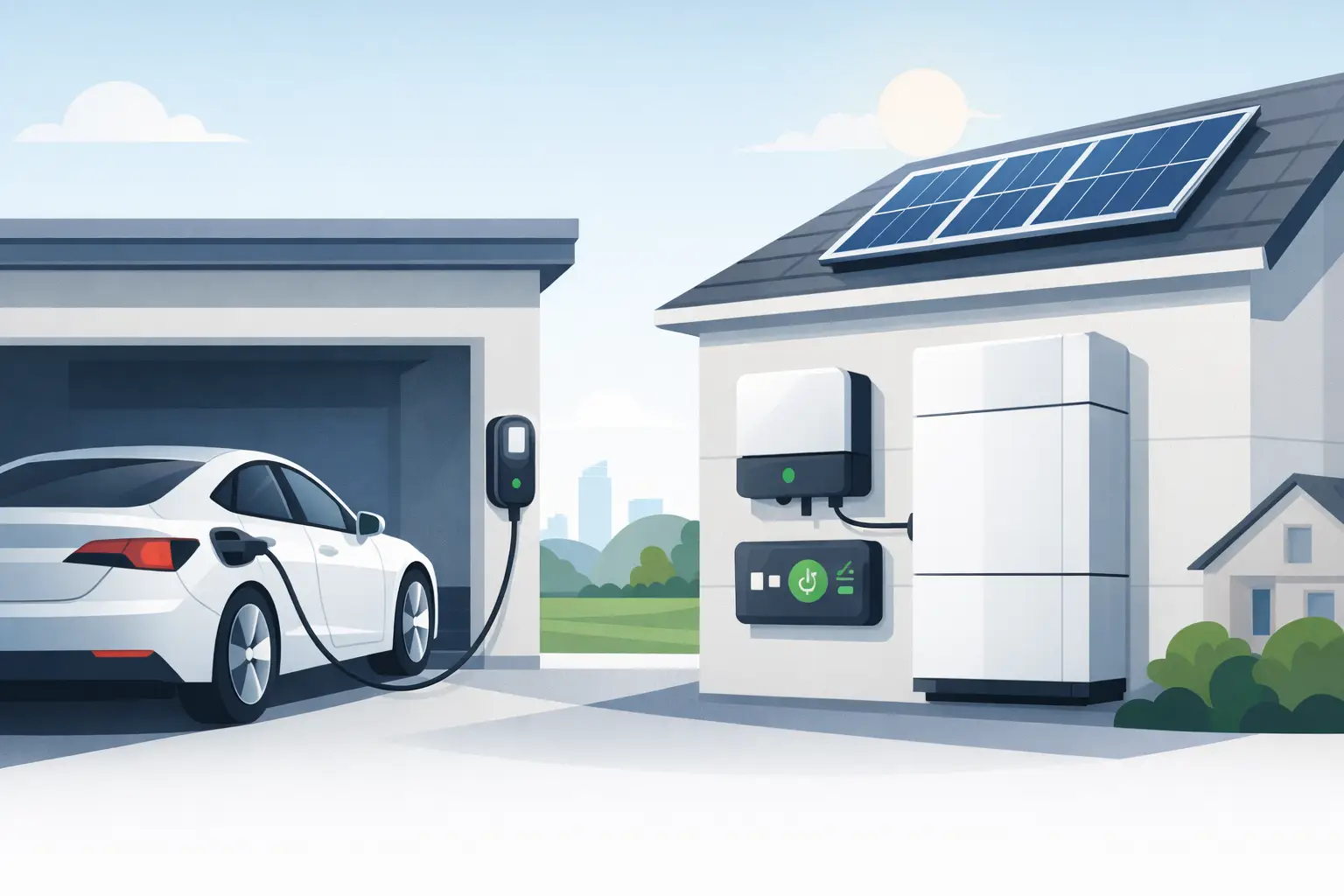
This is the most practical starting point for many homes. You have an EV, a suitable off-peak tariff, and a domestic battery charged from the grid overnight. The car takes its cheaper-rate charge during the same low-cost period, and the battery stores extra lower-cost electricity for the house to use later.
This setup is attractive because it is straightforward. It does not rely on solar panels, and it does not ask you to change every habit in the house. If your main goal is to cut bills with minimal complexity, this is often the strongest option.
It suits households where the EV is charged predictably and daytime home use is meaningful enough to benefit from stored energy. Think people working from home, families with after-school and evening demand, or anyone tired of paying peak prices for ordinary use.
2. The EV-first setup with a modest battery
Some households use most of their electricity budget on the car itself. In that case, the battery does not need to be oversized. A modest system can still make sense if its role is to support the home around the edges of your charging pattern rather than cover everything.
For example, if your EV usually takes most of the overnight cheap-rate window, a smaller battery may still charge enough to cover breakfast-time and early daytime use. That can be more cost-effective than paying for a larger system that rarely gets fully charged.
This arrangement is often sensible for commuters with one EV and moderate household demand. It keeps installation practical while still turning tariff timing into a wider household benefit.
3. The higher-capacity setup for heavier users
If you have two EVs, a larger property, high electricity use or regular daytime occupancy, a bigger battery can be justified. The point here is not just to store more – it is to store enough to make a real dent in expensive-rate imports.
This setup works best when your tariff window is long enough, and your charger, battery inverter and household load are properly considered together. A larger battery with poor control can disappoint. A well-matched one can materially reduce what you buy at peak rates.
It is particularly relevant if you want more control over costs throughout the day, not just cheaper car charging overnight.
EV tariff comparisons and where a battery fits
The battery decision only makes sense when you look at the tariff alongside it. A cheap overnight rate is useful, but the spread between your lower and higher rates is what creates the savings opportunity.
Here is a simple comparison diagram showing how different home charging arrangements can affect household bills.
Diagram 1: EV tariff comparison without battery storage
| Setup | Overnight EV charging | Daytime household use | Likely bill effect | |—|—|—|—| | Standard single-rate tariff | Same price all night | Same price all day | Limited savings from EV charging | | EV tariff only | Lower-rate overnight charging | Daytime use still bought at higher rate | Good EV savings, weaker whole-home savings |
Without a battery, the tariff mainly helps your car. The home still buys much of its electricity at the dearer daytime rate.
Diagram 2: EV tariff comparison with home battery storage
| Setup | Overnight battery charging | EV charging | Daytime household use | Likely bill effect | |—|—|—|—|—| | EV tariff plus battery | Battery charges at lower rate | Car charges at lower rate | Home uses stored cheaper electricity | Better whole-home savings | | EV tariff plus larger battery | More lower-rate energy stored overnight | Car charges at lower rate | More daytime and evening use shifted away from peak imports | Stronger savings where usage is high |
The aim is simple: buy more of your electricity when it is cheaper, then use less of it when it is not. For many households, that is where battery storage starts to move from a nice idea to a practical cost-saving tool.
Best battery setups for EV owners – what to check before choosing
Capacity matters, but usable capacity matters more. You need to know how much energy the battery can actually deliver for daily use, not just the headline figure. A system that looks generous on paper may be less impressive once real operating limits are accounted for.
Charge and discharge rates also matter. If your household demand spikes in the morning or early evening, the battery needs to respond well enough to offset those imports. Otherwise, you may still pull expensive electricity from the grid at the worst moments.
Control software is another quiet difference-maker. The best systems are not awkward to live with. They work with tariff schedules, charge when expected, and discharge predictably. Householders do not want to spend their evenings adjusting settings just to save money.
Installation quality should not be treated as an afterthought. This is a long-term home energy asset, so safety, reliability and aftercare matter. UK-engineered technology and qualified installation are not marketing extras. They are part of what makes the savings dependable rather than theoretical.
When a smaller battery is the better choice
There is a temptation to size for every possible scenario. In practice, many homes are better served by a battery that covers a meaningful part of daytime use rather than trying to replace grid imports entirely.
A smaller system can cost less upfront, cycle more regularly and deliver clearer payback if your usage pattern is modest. It also avoids the frustration of paying for storage capacity you rarely use. That is especially true if your EV already consumes much of the cheap overnight charging window.
This is why good advice matters. The best setup is not a generic answer. It depends on your tariff, your car charging pattern, your daytime use and how much control you want over rising bills.
When a larger setup earns its keep
A larger battery starts to make more sense when your household has enough demand to use that stored electricity consistently. Homes with higher baseline consumption, multiple occupants, regular daytime activity or more than one EV may get more value from extra capacity.
The logic is not complicated. If you can reliably fill the battery at lower rates and reliably use that energy later instead of buying at peak prices, the additional storage has a job to do. If not, the numbers can become less convincing.
That is why honest expectations matter. Battery storage can reduce home charging costs and wider household electricity costs, but it should be sized around real habits, not best-case assumptions.
A practical way to think about it
If your EV tariff already gives you a cheaper overnight window, the next question is not whether battery storage sounds clever. It is whether your home would benefit from carrying more of that lower-cost electricity into the day. For many UK households, the answer is yes, especially when the system is designed around tariff optimisation rather than unnecessary complexity.
At Volt Wiser Energy, that practical approach is the whole point. A well-matched battery setup gives you more control over when you buy electricity, more protection from higher daytime rates, and a simpler route to savings without needing to turn your roof into a project.
The best setup is the one that suits the life you already lead – your commute, your home, your tariff and your budget – and quietly lowers the cost of keeping both your house and your EV running.