You plug the car in overnight because that is when electricity is cheaper. Then the rest of the house starts using power the next morning, and the bill still feels higher than expected. That is usually the point where people ask: do batteries help with EV charging, or are they just another bit of kit to buy?
In many UK homes, the answer is yes – but not in exactly the way people first imagine. A home battery does not magically make charging free, and it will not suit every tariff or every driving pattern. What it can do is give you more control over when you buy electricity from the grid and when you use it. If you charge the battery at cheaper off-peak rates and use that stored power at more expensive times, the overall cost of running an EV and a home can become much easier to manage.
Do batteries help with EV charging in real homes?
They can, especially if your household is already on, or considering, an EV tariff with lower overnight rates and higher daytime rates. Without a battery, you can still charge the car cheaply overnight. The catch is that the rest of your home usually runs on standard grid electricity during the day, when prices are often much higher.
A battery changes that pattern. Instead of only using cheap electricity for the car during the off-peak window, you can also store some of that lower-cost electricity overnight and use it later for your home. That means your EV tariff starts working harder for the whole property, not just the vehicle.
This is why the question is not only whether a battery helps the car charge. It is whether it helps you make better use of your tariff across the full day. For many households, that is where the real savings sit.
How a battery works alongside an EV tariff
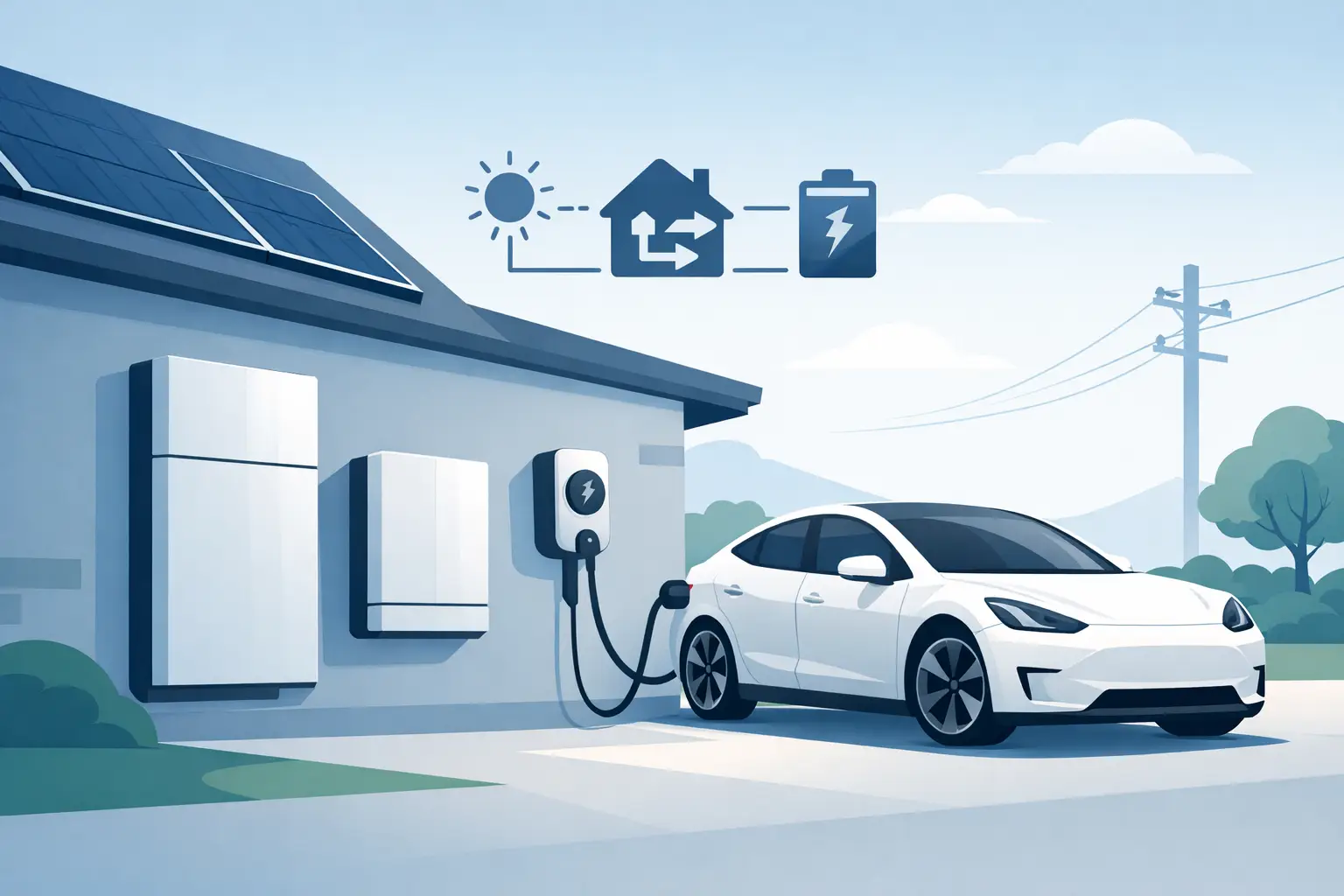
Think of a battery as a holding tank for lower-cost electricity from the grid. During off-peak hours, the battery charges up. Later, when electricity costs more, the battery can supply part of the home’s demand instead of pulling as much from the grid.
If your EV is also set to charge overnight, you are effectively concentrating more of your electricity use into the cheapest available period. That is useful because EV charging can increase total household electricity use quite noticeably, particularly if you drive regularly.
Here is a simple view of how that can look:
Example of an EV tariff without a battery
“`text Time Grid price What happens 00:30-05:30 Low EV charges 05:30-24:00 Higher Home uses grid electricity “`
Example of an EV tariff with a battery
“`text Time Grid price What happens 00:30-05:30 Low EV charges + battery charges 05:30-24:00 Higher Home uses stored battery power first “`
That does not mean the battery will run your whole house all day, every day. Capacity matters, and so does how much electricity your home uses. But even partial coverage during peak periods can make a difference to bills.
EV tariff comparisons – where battery storage can make the biggest difference
Not all tariffs create the same opportunity. A battery tends to make more financial sense where there is a clear gap between cheap off-peak rates and more expensive daytime rates.
Here is a simplified comparison diagram showing the principle rather than a live tariff quote:
“`text EV Tariff Comparison for Home Charging
Tariff Type Night Rate Day Rate Battery Benefit Standard single-rate Medium Medium Lower EV tariff with cheap night Low High Higher EV tariff with narrow window Very low High Higher if timed well Flexible time-of-use Varies Varies Depends on routine “`
And here is the household bill effect in simple terms:
“`text Without battery Cheap overnight power -> mainly benefits the EV Daytime household use -> bought at higher rate
With battery Cheap overnight power -> benefits the EV and charges battery Daytime household use -> partly covered by stored lower-cost power “`
For a homeowner trying to reduce bills, this is often the most practical reason to install battery storage. It is less about speeding up charging and more about reducing the cost impact of owning and charging an EV at home.
What batteries do well – and what they do not
A battery is good at shifting electricity use from one time of day to another. That matters because energy pricing is increasingly based on when you use power, not just how much you use.
It also helps smooth out demand in busy households. If the car has charged overnight and the battery has also charged overnight, your morning and evening electricity use can draw less from the grid at expensive times. That can be particularly useful for homes with electric cooking, working from home, or family routines that push usage into peak periods.
What a battery does not do is eliminate your need for grid electricity. If the battery is empty, your home still imports power as normal. It also does not guarantee savings if your tariff structure is flat or if your overnight usage is too low to make charging worthwhile. As with most household upgrades, the outcome depends on the tariff, the battery size, your EV mileage and your day-to-day routine.
When a home battery makes the most sense for EV charging
The strongest case usually looks like this: you have an EV, you charge mainly at home, you are on a time-of-use tariff, and your daytime electricity is noticeably more expensive than your overnight rate. In that situation, a battery can improve the value of the tariff you already have.
It can also suit homeowners who want savings without adding solar panels. That matters because many people assume battery storage only works as part of a larger renewable system. In reality, grid-charged battery storage can stand on its own as a bill-reduction tool if your tariff allows you to buy electricity cheaply at the right times.
For households that like predictable costs, there is another benefit. A battery can reduce exposure to the most expensive periods of the day. You still buy electricity from the grid, but you are buying more of it when it is cheaper and using less of it when it is dearer.
The trade-offs to understand before you decide
A battery is not a one-size-fits-all answer. The upfront cost matters, and so does choosing a system sized properly for your home. Too small, and it may not store enough off-peak electricity to shift much daytime use. Too large, and you may pay for capacity you rarely need.
Charging habits matter too. If your EV often charges outside the cheap overnight window because of irregular journeys, a battery may help less than expected. Equally, if you are home very little during the day and use minimal electricity outside the overnight period, the extra value from storage may be smaller.
There is also the practical side. A battery system should be installed properly, configured around your tariff and backed by clear guidance. For most homeowners, that reassurance is just as important as the technical specification.
A simple way to think about the savings
If your EV tariff gives you a cheap rate overnight, you already have one part of the puzzle. The battery gives you another option: storing some of that low-cost electricity so it can do more than charge the car.
The result is not just an EV charging strategy. It becomes a whole-home tariff strategy.
That is often what makes domestic battery storage appealing. It takes an existing cost pressure – higher household electricity use after buying an EV – and turns it into something you can manage more deliberately. For many UK households, that is a more useful benefit than any technical claim about charging performance.
A straightforward, professionally installed system using UK-engineered technology can make that process feel far less complicated than people expect. Brands such as Volt Wiser Energy focus on exactly that point: helping homeowners use off-peak electricity more effectively, without making the process feel overly technical or dependent on extra add-ons.
So, do batteries help with EV charging?
Yes, if by “help” you mean lowering the overall cost of running your EV at home and making better use of an EV tariff. They help less by changing the car itself, and more by changing how your household buys and uses electricity.
For the right home, that can be a smart move. Especially if you want lower bills, more control and a practical way to make home charging work harder for your budget.
Before making a decision, the best question is not simply whether a battery works. It is whether your tariff, your driving pattern and your household electricity use give that battery enough opportunity to earn its place.