A lot of households look at their electricity bill, see the day rate, and assume there is not much they can do about it. The useful part of an example of battery tariff savings is that it turns the idea into real numbers. Once you can see how a battery shifts cheaper overnight electricity into the expensive part of the day, the saving stops feeling theoretical.
For many UK homes, the opportunity is not about generating electricity. It is about buying it at a better time, storing it, and using it later. That matters even more if you also charge an electric car at home, because the gap between off-peak and peak prices can be large enough to make tariff timing a genuine household cost-saving tool.
A simple example of battery tariff savings
Take a home using 12 kWh of electricity each day, excluding electric vehicle charging. Let us say the household is on a time-of-use tariff with a night rate of 9p per kWh and a day rate of 32p per kWh. Without a battery, most of that electricity is likely to be used during the day and evening, when the price is highest.
Now assume the home installs a domestic battery that can store 10 kWh overnight. In practice, not every stored unit comes back out because there are efficiency losses, so let us use a realistic usable figure of 8.5 to 9 kWh delivered back into the home the next day.
If that 9 kWh would otherwise have been bought at 32p, but was instead bought overnight at 9p, the gross price difference is 23p per kWh. Across 9 kWh, that is a daily saving of £2.07. Over 30 days, it becomes £62.10. Over a full year, that works out at roughly £755, assuming the household can make good use of the stored power most days.
That does not mean every home will save exactly that amount. Your actual result depends on the tariff, how much electricity you use during peak periods, battery size, and how consistently the battery cycles. Still, this is the sort of clear, measurable saving that makes people take a second look.
Why the savings can be higher than people expect
The biggest misunderstanding is thinking a battery only helps if you have panels on the roof. For many homes, the stronger case is simple tariff shifting. You charge the battery when electricity is cheap, then use that stored electricity when the tariff rises.
If your busiest usage happens between late afternoon and bedtime, that is often where the value sits. Cooking, washing, lighting, televisions, computers and general family life tend to cluster into the most expensive hours. A battery does not remove your need for grid electricity altogether, but it can reduce how much of it you buy at the worst time.
This is also why straightforward advice matters. You are not trying to become an energy trader. You are trying to reduce avoidable spend without adding complexity to daily life.
The home battery example with EV tariff comparisons
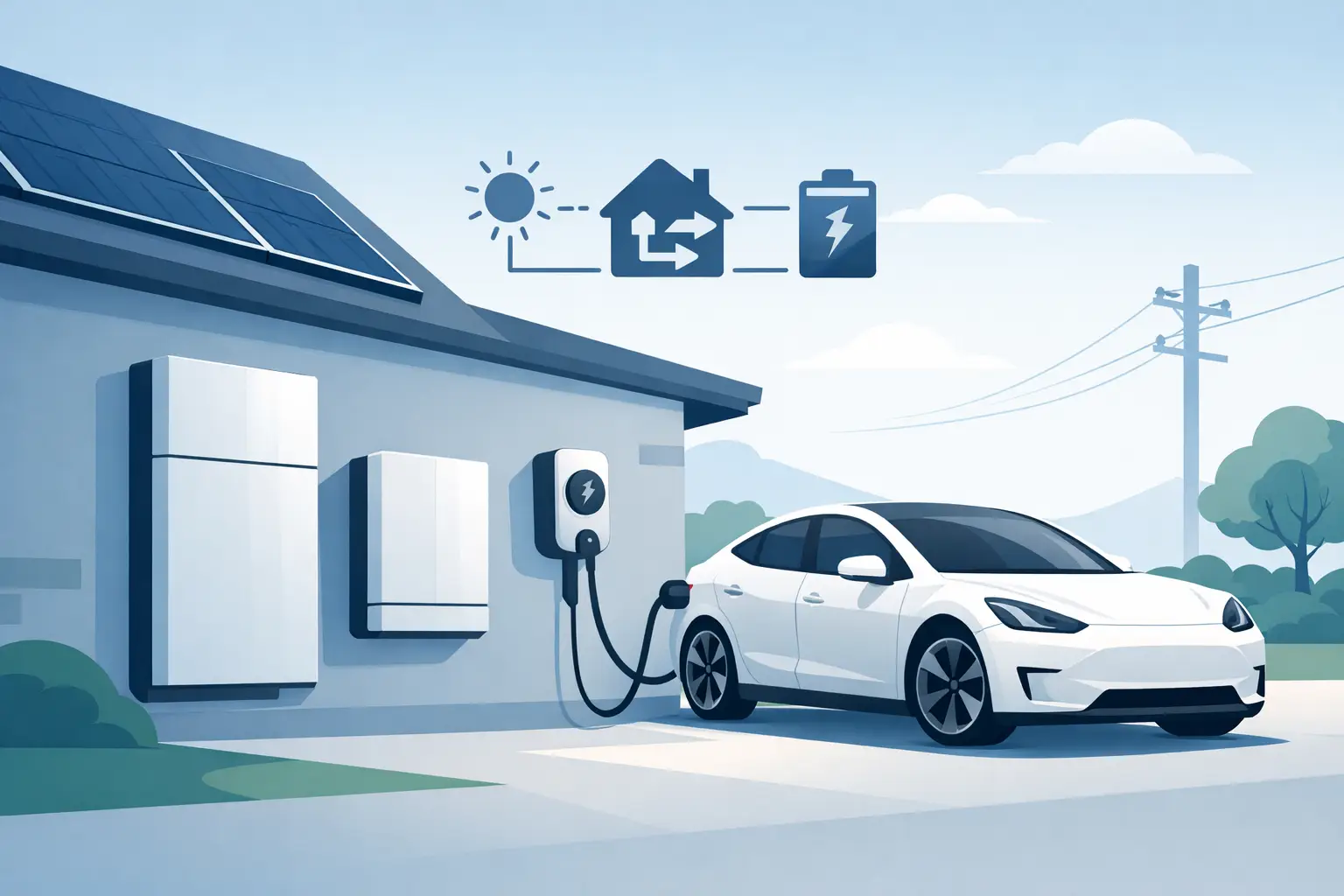
Adding an electric car changes the picture because vehicle charging can be a large share of monthly electricity use. The tariff that works best for the car does not always work best for the rest of the household, unless you have a battery helping to balance things.
Here is a simple comparison using illustrative numbers.
Scenario A: EV tariff, no battery
Assume a household uses 12 kWh per day for normal living, plus 8 kWh overnight for EV charging. The tariff offers 7p per kWh overnight for the car-friendly window, but 34p per kWh in the daytime.
The EV charge is cheap, which is excellent. The car costs only 56p for that 8 kWh session. But the rest of the home still uses much of its electricity during the day. If 9 kWh of household use lands in peak hours, that costs £3.06, with the remaining 3 kWh used overnight costing 21p. Total daily cost comes to £3.83.
Scenario B: EV tariff with battery
Now keep the same tariff, but add a battery that charges overnight alongside the car. The battery takes in cheaper overnight electricity and supplies 9 kWh back to the home during the expensive daytime period.
The car still costs 56p to charge. The battery energy for the home costs 63p to buy overnight if we use 9 kWh at 7p. That same 9 kWh would have cost £3.06 at the daytime rate. The difference is £2.43 per day on household use alone. Add the remaining 3 kWh of overnight household demand at 21p, and total daily cost falls to about £1.40.
That is a reduction of roughly £2.43 per day compared with the no-battery version of the same EV tariff.
EV tariff comparison diagram
Below is a simple text diagram to show how the numbers stack up.
Daily cost comparison
“`text HOME + EV USING TIME-OF-USE TARIFF
Scenario A – EV tariff, no battery
EV charging overnight: 8 kWh x 7p = £0.56 Home use overnight: 3 kWh x 7p = £0.21 Home use daytime: 9 kWh x 34p = £3.06
Total daily cost = £3.83
Scenario B – EV tariff with battery
EV charging overnight: 8 kWh x 7p = £0.56 Battery charged overnight: 9 kWh x 7p = £0.63 Home use overnight direct: 3 kWh x 7p = £0.21 Daytime home use from battery = £0.00 at peak rate
Total daily cost = £1.40
Estimated daily reduction = £2.43 Estimated monthly reduction = about £73 Estimated yearly reduction = about £887 “`
The exact figures will vary by tariff and battery performance, but the pattern is the important part. A home with an electric car can benefit twice – once from cheaper overnight charging for the vehicle, and again from shifting household use away from the expensive daytime rate.
Where battery tariff savings are strongest
The strongest results usually appear in homes with one or more of these traits. First, they have a meaningful gap between cheap overnight electricity and expensive daytime electricity. Second, they use a fair amount of power in the evening. Third, they are disciplined enough, or automated enough, to charge the battery in the off-peak window consistently.
A battery is often especially attractive for households where someone is home during the day, where electric cooking is common, or where an EV adds more focus to tariff choice. The battery then supports the whole property, not just one appliance.
What can reduce the saving
There are trade-offs, and it is better to be clear about them. If the difference between night and day rates is small, the saving shrinks. If you use most of your electricity overnight already, there is less daytime spend to offset. If the battery is too small for your usage, you may still buy peak-rate electricity in the evening once stored energy runs out.
Efficiency losses matter too. A battery is not a perfect bucket. Some energy is lost in charging and discharging, which is why realistic calculations should never assume every unit bought overnight is delivered back in full.
There is also the question of tariff fit. A tariff that looks excellent for EV charging may have a steeper daytime rate than a standard plan. Without a battery, that can leave the rest of the house exposed to higher costs. With a properly sized system, the equation can improve significantly.
How to judge your own likely saving
The best starting point is not the battery specification. It is your pattern of use. Look at when you use electricity, not just how much. If your home does most of its consuming between breakfast and bedtime, and especially in the late afternoon and evening, battery storage may have a clear role.
Then compare your available tariff options. Focus on the gap between off-peak and peak rates, your expected overnight charging window, and whether your EV charging needs leave enough room for the battery to charge fully as well. In many cases, a well-matched system can work quietly in the background and reduce the expensive units you would otherwise buy every day.
This is where a practical, transparent approach matters. A dependable installer should talk through battery size, tariff suitability, expected cycling, and likely savings without overpromising. That is far more useful than vague claims about energy independence.
For households that want simpler control over electricity costs, this kind of example of battery tariff savings is not really about clever technology for its own sake. It is about buying electricity more wisely, using more of it on your terms, and making your home – and your EV charging – less exposed to the most expensive hours of the day.