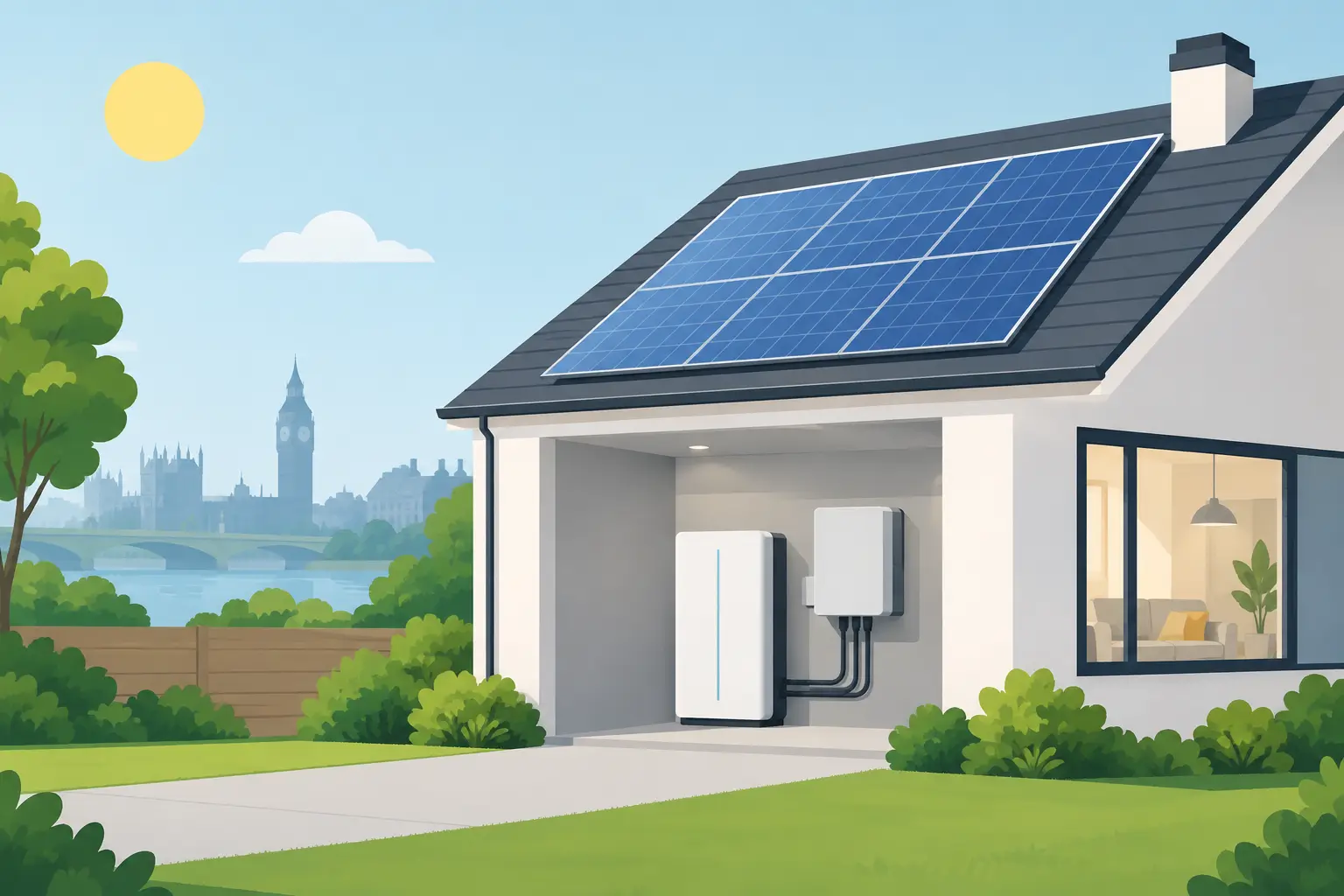

A cheap overnight rate is only valuable if your home can make use of it. Battery tariff optimisation gives a household a practical way to do that: charge a domestic battery from the grid when electricity costs less, then use the stored electricity when daytime rates rise. For many UK homeowners, it is a route to lower bills without fitting panels to the roof or changing how they live.
The principle is straightforward. Your electricity supplier charges different prices at different times of day. A battery system is programmed around those prices, taking low-cost electricity during the agreed off-peak window and supplying power back to the home at more expensive times. The value comes from the gap between the two rates, your household’s electricity use and the usable capacity of the battery.
How battery tariff optimisation works
A time-of-use tariff typically offers a lower overnight price when national demand is lower, followed by a higher day rate. Rather than buying all of your electricity at the higher rate as the day unfolds, a battery can buy a portion of it in advance at the lower rate.
A qualified installer sets up the system so it charges during your tariff’s lower-cost hours. Once that period ends, the battery is ready to support the home through breakfast, daytime use and the evening peak. The grid remains available at all times, so the battery does not need to cover every unit of electricity your household uses to make a difference.
“` Typical time-of-use pattern
Overnight off-peak Daytime and evening Lower electricity price Higher electricity price | | v v Grid charges battery Battery supports home [ Battery fills ] —————-> [ Battery discharges ] “`
This is not about guessing tomorrow’s energy market. It is about using the rates published on your chosen tariff and matching battery charging to the periods where the price difference is meaningful.
The savings depend on what you replace
The most useful question is not simply, “How cheap is the overnight rate?” It is, “Which expensive electricity will the battery replace?” A home that uses more power in the morning and evening often has more opportunity than one that uses very little outside the lower-price window.
For example, stored electricity may cover lighting, cooking, refrigeration, television, home office equipment and other normal household demand during the costlier part of the day. If the battery reaches its minimum reserve before bedtime, the home returns to grid supply as normal. If it is not fully used, that is not a fault – it may simply mean household demand was lower than expected.
Battery efficiency also matters. Some electricity is lost during charging and discharging, so the price gap must be large enough to leave a worthwhile saving after those losses. A transparent assessment should use realistic figures rather than presenting every low-cost unit as if it can be used again in full.
Battery tariff optimisation and home EV charging
An electric vehicle can make a time-of-use tariff especially attractive because charging demand is often substantial and can usually be scheduled overnight. However, the car and the battery should be planned together. They are both competing for the same low-cost charging window, and a household needs enough supply capacity, time and tariff allowance for its priorities.
In many cases, the most cost-effective approach is to charge the EV directly from the grid during the overnight window, while the home battery also charges for daytime household use. The battery is not normally intended to refill an EV during the day. Doing so adds conversion losses and can empty the stored electricity that would otherwise offset higher-rate household use.
“` EV tariff comparison at home
Option A: Charge EV at daytime rate Grid at higher rate —————————-> EV Household electricity also bought at higher rate
Option B: Use an EV-friendly overnight tariff Grid at lower off-peak rate —–> EV charger -> EV
—> Home battery -> Home use later
Aim: reduce the total household bill, not just the EV charging cost. “`
The second option can work well where the lower-rate window is long enough for both loads. A smart charger can schedule the vehicle, while the battery system follows its own agreed charging programme. Your installer should consider the maximum demand of the property and charging equipment, particularly where an EV charger, electric heating or other high-load appliances may operate at similar times.
Choosing priorities when the off-peak window is limited
If your car needs a large charge every night, it may take priority over filling the battery completely. That does not mean a battery is unsuitable. It means the expected household savings should be based on the capacity you can reliably charge after the EV’s needs are met.
Conversely, a driver who charges only a few nights each week may have plenty of low-cost electricity available for both the car and the battery. The right setup depends on mileage, vehicle battery size, household consumption, tariff timings and the electrical capacity of the home.
What makes a tariff suitable?
A tariff with a low overnight headline rate is not automatically the best choice. Look at the whole structure: the daytime price, the length and timing of the off-peak period, any standing charge, and whether the tariff suits your usual household and driving habits.
A short low-price period can still be useful, but it needs to provide enough time to charge the battery and, where relevant, the EV. A very low overnight rate paired with a notably high daytime rate can favour a battery if it is correctly sized and consistently charged. Yet households with low daytime and evening demand may see less benefit because there is less expensive electricity for the battery to replace.
Tariffs can change, and suppliers may update rates or time windows. That is why battery settings should not be treated as a one-off job. A system should be reviewed when you change tariff, buy an EV, alter your working pattern or add a major electrical load such as a heat pump.
Getting the system size right
Bigger is not always better. A battery that is far larger than the amount of low-cost electricity you can charge, or the expensive electricity you can use later, may take longer to pay for itself. A battery that is too small may regularly run out before the evening peak is over.
A sensible recommendation starts with your smart-meter data where available. It should consider your daily electricity use, when that use occurs, your current tariff, the likely tariff you may move to and any planned EV charging. It should also account for seasonal differences. Winter consumption can be higher, while a vehicle may be away from home on some nights and connected on others.
The goal is not perfect self-sufficiency. It is to install a dependable system that moves a useful amount of your electricity spend from higher-cost periods into lower-cost ones.
Practical setup and peace of mind
Grid-charged home batteries are a relatively straightforward upgrade for many standard UK properties. Professional installation remains essential. The battery, inverter, protection equipment and monitoring need to be selected and installed correctly, with the work matched to the property’s electrical setup.
At Volt Wiser Energy, the focus is on clear advice, qualified installation and UK-engineered ESME Energy technology. A good installation conversation should cover where equipment will be located, how the system will operate during its charging window, what monitoring you can expect and the assumptions behind any savings illustration.
It is also worth being realistic about backup power. Not every battery installation provides electricity during a power cut. That depends on the equipment specification and how it is configured. If resilience is important to you, ask about it before installation rather than assuming it is included.
Questions homeowners often ask
Will a battery lower every electricity bill?
Not necessarily. Savings rely on a suitable tariff, a meaningful difference between off-peak and peak prices, and enough household demand at the more expensive times. The system must also be charged consistently during the lower-cost period.
Can I change electricity supplier after installation?
Usually, yes, but check the new tariff’s times and prices before switching. The battery charging schedule may need adjusting so it continues to buy electricity at the intended low-cost rate.
Do I need to manage it every day?
No. Once configured, the system should follow its programme automatically. You may choose to check monitoring data, particularly in the first few weeks, but the purpose is to reduce effort rather than create another daily task.
The most productive first step is to look at when your household uses electricity, not just how many units you use in total. That pattern reveals whether a battery and a well-chosen tariff could turn overnight electricity into a steadier, more manageable household cost.