
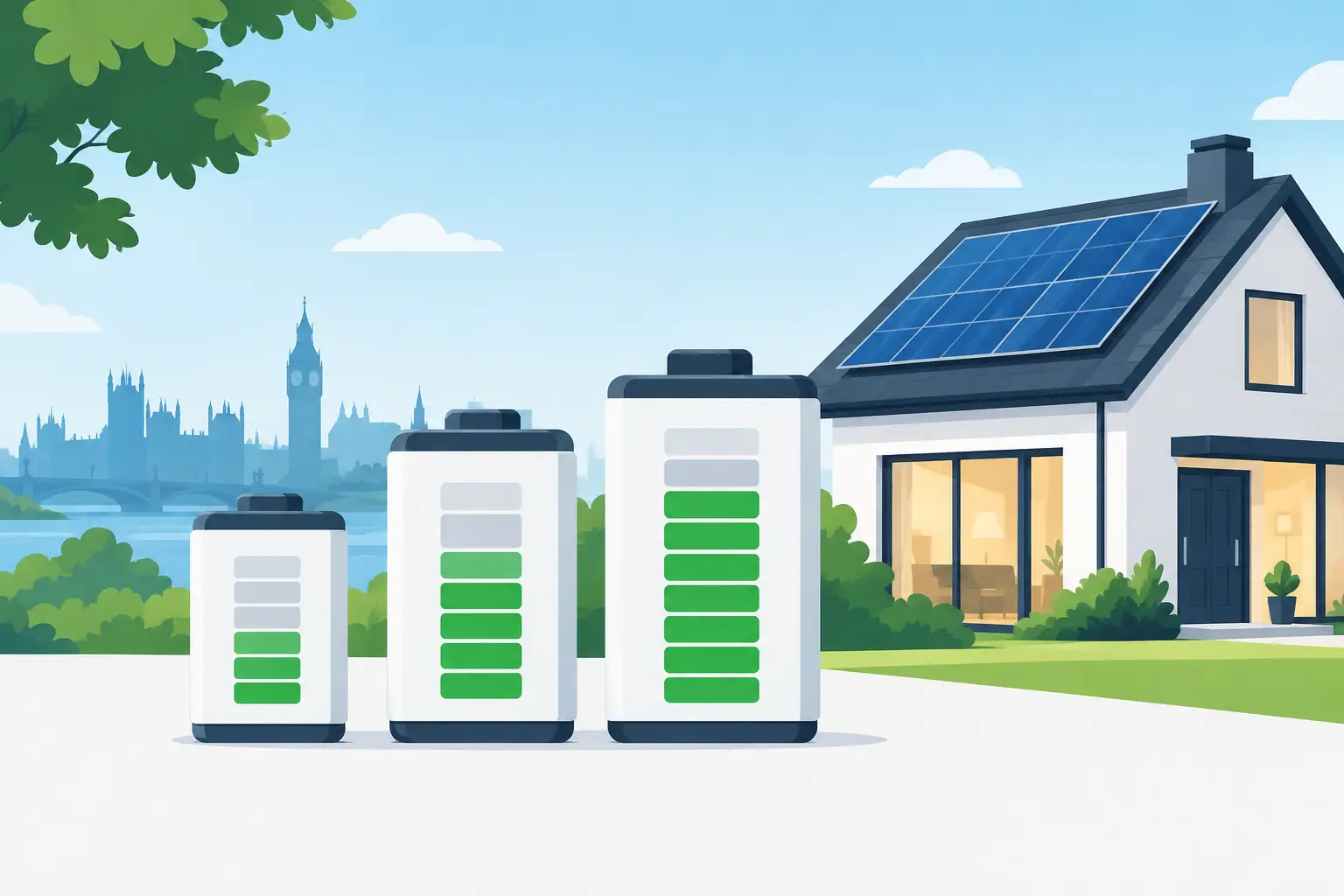
A battery that is too small can run out before the expensive evening period is over. One that is far larger than your household can use may take longer to repay its cost. A useful battery capacity comparison is therefore not about buying the biggest unit available. It is about matching usable storage to your electricity use, tariff hours and, if you have one, your electric vehicle.
For many UK homes, a grid-charged battery creates a practical way to buy electricity at a lower overnight rate and use it later, when standard daytime electricity costs more. No panels are required. The battery charges from the grid during your cheaper tariff window, then supports household demand during higher-priced hours.
What battery capacity means in practice
Battery capacity is measured in kilowatt-hours, or kWh. This tells you how much electricity the battery can store. A 10 kWh battery can deliver up to 10 kWh of stored energy, subject to its usable capacity, settings and normal operating losses.
Capacity is different from power. Power, measured in kilowatts (kW), affects how quickly a battery can charge or discharge. A battery with ample capacity but a low discharge rate may not cover every high-demand appliance running at once. Conversely, a high-power unit with limited capacity may empty early.
For bill reduction, usable capacity is the number that matters most. Manufacturers may quote a total figure, but batteries usually keep a small reserve to protect their cells and support a long service life. Ask for the usable kWh figure, as well as the battery warranty, discharge power and expected installation arrangement.
A simple way to think about capacity is this: your battery needs enough stored overnight electricity to cover the part of your daytime and evening consumption you want to shift away from the higher tariff.
Battery capacity comparison: 5 kWh, 10 kWh or 15 kWh?
There is no single right size for every property. Household size, working patterns, electric heating, cooking habits and tariff window all make a difference. The comparison below shows how common capacity ranges can suit different starting points.
| Usable battery capacity | Often suited to | What it can do well | Where it may fall short | |—|—|—|—| | Around 5 kWh | Smaller homes or low daytime use | Covers a portion of morning and evening demand | May empty quickly where several people are home during the day | | Around 10 kWh | Many average family homes | Provides meaningful coverage across peak-price periods | May not cover a full high-use day with an EV and electric heating | | Around 15 kWh or more | Larger or higher-use households | Gives more flexibility and a larger off-peak energy store | Needs enough regular demand to justify the added capacity |
The figures are not promises of savings. Your actual result depends on the gap between your off-peak and peak unit rates, standing charges, your battery settings and how much stored electricity you use before the next charging window.
Here is a simplified household example. It assumes a home uses 12 kWh between the end of its overnight low-rate period and the next overnight charge.
“`text Illustrative daily household demand: 12 kWh
5 kWh battery [#####——-] Covers about 5 kWh of higher-rate use 10 kWh battery [##########–] Covers about 10 kWh of higher-rate use 15 kWh battery [############] Can cover demand and retain flexibility
The best fit is not automatically 15 kWh. It is the capacity you can charge cheaply and use regularly. “`
If a 15 kWh system regularly finishes the day with a large amount of stored electricity left, the additional capacity is not doing as much work as expected. If a 5 kWh system is empty by breakfast or early evening, a larger battery could shift more of your consumption to the lower rate.
Start with your overnight charging opportunity
A battery only saves money if it can charge sufficiently during your cheaper period. This depends on the tariff window, the battery charger’s power and other demand in the house.
For example, a 10 kWh battery that charges at 3 kW needs more than three hours to fill from empty, allowing for normal losses. A longer off-peak window can make a larger battery more practical. A shorter window may favour a capacity that can reliably recharge each night.
This is why tariff choice and battery size should be considered together, rather than as separate decisions.
EV tariff comparisons: battery and car charging together
An EV can transform a household’s electricity profile. It can also create competition for cheap overnight electricity if the car and home battery charge at the same time. The aim is not simply to charge everything overnight. It is to do so within your supply capacity and tariff window, while reducing the electricity you need to buy at higher daytime rates.
The diagram below uses illustrative rates only. Real tariff prices, windows and eligibility change, so always check the current details from your supplier before deciding.
“`text Illustrative EV tariff comparison
Off-peak window Low rate Day rate Best use Standard tariff No fixed cheap window 28p/kWh 28p/kWh Limited battery arbitrage EV time-of-use 00:30-04:30 9p/kWh 30p/kWh EV and battery overnight charging Longer EV window 23:30-05:30 10p/kWh 31p/kWh More room for larger batteries
Example overnight plan on an EV tariff
00:30 02:30 04:30 Daytime |———-|——————|—————————| Battery Battery/EV split EV finishes Battery supports home charges if supply allows charging at higher rate
Result: cheaper overnight electricity is stored or used for driving, reducing household purchases at the higher daytime rate. “`
If your car requires a large charge every night, it may use most of the available low-rate window. In that case, the household battery may need intelligent scheduling, a longer off-peak tariff period or a charging plan that reflects how often the car is actually driven.
A car does not necessarily need to be charged to full every night. Charging to match expected mileage can leave more off-peak capacity for the home battery, provided it suits your routine. Qualified installers and tariff-aware system settings can help prevent the battery and EV charger from drawing more power together than your property’s supply arrangement comfortably supports.
How to choose the right capacity
Start with your smart meter data or electricity statements. Look beyond annual consumption and focus on when you use power. A household that is empty for most weekdays may have a different requirement from one where people work from home, cook electrically and use appliances throughout the day.
Next, identify your tariff’s cheaper hours and compare the low-rate price with the daytime price. The wider the difference, the more value there can be in shifting electricity with a battery. Then consider how much electricity you typically use outside the low-rate window. That is the demand a battery may be able to cover.
It also helps to separate essential household load from occasional high consumption. Lights, refrigeration, broadband, cooking and television are regular demands. Tumble dryers, electric showers and home charging can cause higher short bursts. Capacity affects how long stored power lasts; discharge power affects how well the battery can respond to those bursts.
Do not size a system solely around an unusually high-use day. A battery should earn its place on ordinary days, not just cope with the household Christmas meal, a cold snap and every appliance running at once.
A practical sizing example
Suppose your household uses around 9 kWh from the end of an overnight low-rate period until the next charge window. A battery with roughly 10 kWh of usable capacity could potentially cover much of that demand, assuming it is charged fully at the lower rate and the system is configured appropriately.
If the home regularly uses 14 kWh during those higher-rate hours, a 5 kWh unit will still reduce bills, but it will leave more electricity to buy at the peak rate. A larger capacity may offer greater savings, but only if the tariff window and charger power allow it to refill consistently.
That last point matters. Storage that cannot be reliably replenished on a cheap tariff is not providing its full value.
Questions worth asking before installation
A clear proposal should explain the system’s usable capacity, charge and discharge rates, warranty terms and likely operating strategy. It should also show how the battery will respond to your tariff, rather than relying on broad savings claims.
Ask whether the system can be expanded later if your needs change, particularly if you are considering an EV or expect household electricity use to rise. Modular expansion can be useful, but it is not always the lowest-cost route, so it should be weighed against installing the appropriate capacity from the outset.
Safety and installation quality matter as much as the battery specification. A professionally installed UK-engineered system, correctly assessed for your property and supported by clear guidance, gives you a more dependable foundation for long-term savings.
Volt Wiser Energy approaches capacity as a household and tariff decision, not a one-size-fits-all product choice. The most useful next step is to examine your actual usage pattern and choose a battery that can turn your regular overnight low-rate electricity into lower-cost power when your home needs it most.