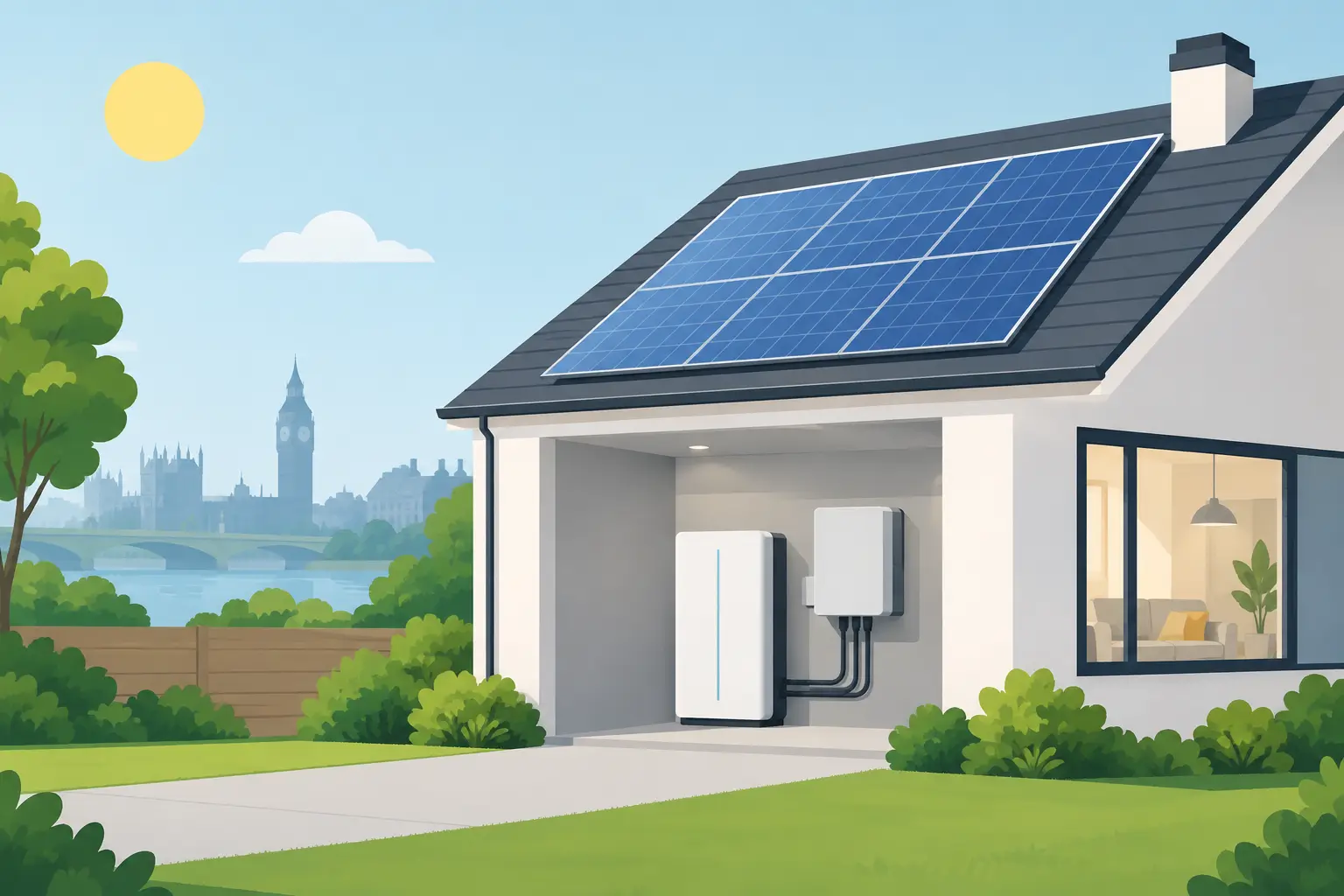

If your electricity is cheaper at 2am than it is at 2pm, the obvious question is why pay the higher rate at all. That is where battery storage tariff savings come in. Instead of using expensive daytime electricity straight from the grid, a home battery can charge overnight on your lower Economy rate and then power part of your home later in the day, when electricity costs more.
For many UK households, that idea is far more practical than people first assume. You do not need solar panels. You do not need to generate your own electricity. And you do not need to become an energy expert. You are simply buying electricity when it is cheaper, storing it, and using it when it would otherwise cost more.
How battery storage tariff savings actually work
Tariffs give you two electricity prices. You get a cheaper off-peak rate for roughly seven hours overnight, and a higher peak rate during the day. The exact times and prices depend on your supplier and meter setup, but the basic structure is the same.
A domestic battery system can be programmed to charge during that cheaper overnight window. Then, during the day and evening, your home draws from the battery first before taking more expensive electricity from the grid. The saving comes from the difference between those two unit rates.
That is the core principle. It is not complicated, but it does rely on one thing being true: the gap between your cheap overnight electricity and your daytime electricity needs to be large enough to make battery use worthwhile.
Why this can work even without solar panels
A lot of people still think batteries only make sense if they are paired with solar. That is understandable, because home batteries are often marketed that way. But a battery does not really care where the electricity comes from. It can store power from solar panels, or it can store power from the grid.
For homes on grid charging can be the whole point. If your battery fills overnight at a lower rate and helps you avoid buying electricity at a higher daytime rate, the battery is doing a money-saving job regardless of whether you have panels on the roof.
That matters because solar is not right for every home. Some properties are shaded, some roofs are awkward, and some homeowners simply do not want the cost or disruption of a solar installation. Battery-first systems remove that barrier and make tariff optimisation available to more households.
What affects your battery storage savings.
The headline idea is simple, but real savings vary from home to home. The biggest factor is your tariff spread. If your overnight rate is much lower than your daytime rate, the opportunity is stronger. If the difference is small, the saving per stored unit is smaller too.
Your household usage pattern matters as well. Homes that use a fair amount of electricity in the morning and evening are often better suited than homes that are empty all day and use very little outside off-peak hours. A battery is most useful when it can replace expensive units you would otherwise have bought at the higher rate.
Battery size also plays a part. Too small, and it may run out before the most expensive part of the day is over. Too large, and you may pay for storage capacity you do not often use. The best result usually comes from matching the battery to your actual demand rather than choosing the biggest system available.
Efficiency is another factor. No battery is 100 per cent efficient. A small amount of energy is lost when charging and discharging. That means the saving is not just the simple difference between cheap and expensive tariff rates. It needs to account for those losses. A good system can still produce worthwhile savings, but it is better to be realistic than to rely on inflated claims.
The homes most likely to benefit
Battery storage tends to make sense for homeowners who already understand that their tariff structure can work in their favour. If you are on Economy 7 and regularly use electricity during higher-rate periods, there is a clear reason to look at storage.
This often includes households with predictable daily routines, people working from home, families cooking in the evening, and homes with electric heating or hot water patterns that do not fit neatly into overnight cheap-rate windows. Even modest daytime demand can add up when unit prices are high enough.
It can also appeal to homeowners who want bill control rather than simply lower annual spend. There is value in shifting more of your usage onto cheaper electricity, especially at a time when tariffs can feel unpredictable. A battery gives you more control over when you buy power, not just how much you use.
Where the savings can fall short
Not every property will see the same result, and that is worth saying plainly. If your daytime electricity use is low, your battery may not discharge enough each day to justify the investment as quickly. If your Economy 7 tariff is not especially competitive, the maths may be less attractive.
There is also the question of system management. A properly configured battery should charge and discharge automatically, but setup matters. If charging windows, reserve settings or household priorities are wrong, performance can suffer. That is why professional installation and sensible advice matter just as much as the hardware itself.
Another point is that tariffs change. A setup that works well today still needs to make sense if supplier pricing shifts later. That does not mean battery storage is risky by default, but it does mean households should focus on realistic savings over time rather than one perfect example based on a single tariff snapshot.
Why installation quality matters as much as the tariff
A battery is not just a box on the wall. It is part of your home’s electrical system, and it needs to be installed safely and set up correctly. That means using qualified installers, understanding your home’s demand, and recommending a system size that fits your usage rather than forcing a one-size-fits-all approach.
This is where a straightforward, education-led approach helps. Homeowners do not need jargon. They need to know what the battery is expected to do, what level of savings is realistic, and how the system will behave day to day. A dependable installer should be able to explain all of that in plain English.
For the same reason, battery quality matters. UK households are not looking for speculative energy tech. They are looking for safe, reliable, long-term performance. The right system should feel like a practical home upgrade, not an experiment.
A simple way to think about the numbers
If you charge a battery overnight using electricity that costs significantly less than your daytime rate, each usable unit you shift can reduce what you would otherwise spend the next day. Over weeks and months, those shifts add up.
But the right question is not just, “Can I save money?” It is, “How much of my expensive electricity can I realistically replace?” That depends on your battery capacity, your daily usage, your tariff gap and the system’s efficiency.
A careful estimate should be based on actual household patterns. That is far more useful than broad claims. A good savings calculation should show you whether the likely return suits your home, not whether battery storage sounds impressive in theory.
Why this appeals to mainstream households
The strongest case for grid-charged battery storage is that it makes energy savings more accessible. You do not need the right roof. You do not need to plan a full renewable retrofit. You do not need to wait until your home is perfect.
You just need a tariff that rewards off-peak use and a battery system designed to take advantage of it. For many homeowners, that feels manageable. It is a practical step, not a major lifestyle change.
That is also why brands such as Volt Wiser Energy position battery storage around clarity rather than hype. The appeal is simple: lower the cost of the electricity you already need by buying more of it at the right time.
Is battery storage economically worth it?
For the right home, yes – but only when the numbers stack up. The best candidates are households with a decent gap between off-peak and daytime electricity prices, regular higher-rate consumption, and a system sized sensibly for their usage.
For others, the benefit may be more modest. That does not make battery storage a bad idea, but it does mean expectations should be grounded in real household data and a proper understanding of how the tariff works.
The useful way to look at it is this: Economy tariffs already gives you a pricing advantage overnight. A battery simply helps you keep more of that advantage for later, when your home actually needs the electricity. If that fits how your household uses power, it can be a very sensible way to take some pressure off your bills.